 Fraunhofer Institute for Surface Engineering and Thin Films IST
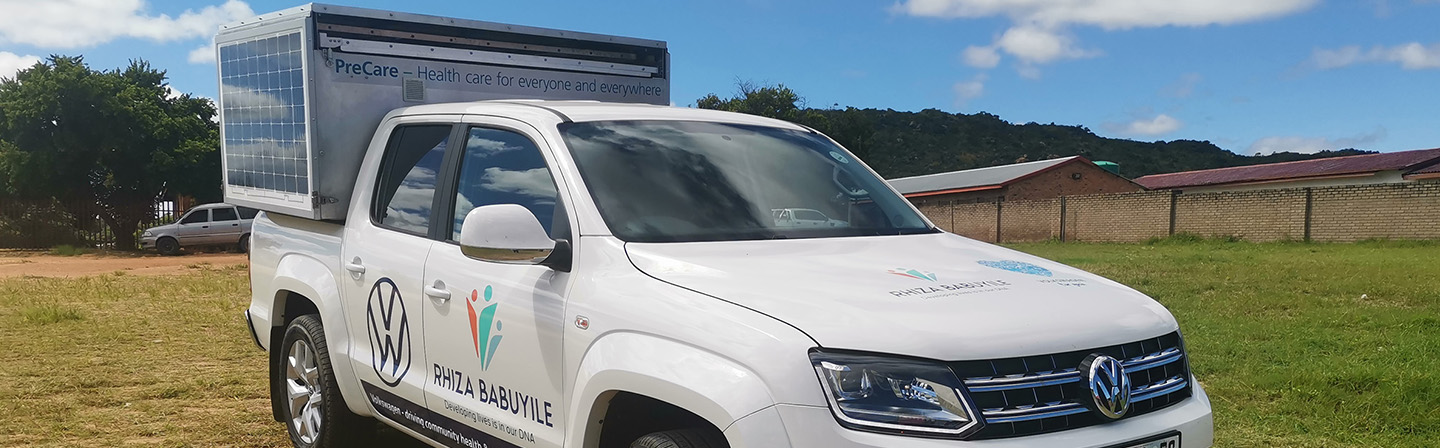
The first prototype of the supply unit mounted on a Volkswagen Amarok.
© Fraunhofer IST, Frank Neumann

PreCare now also in Namibia: With the Mudiro e.V. association, another NGO has been recruited for the future trial operation of a second platform in Namibia. This platform was manufactured entirely in Africa and went into operation in April 2024 as part of a program for the early detection and prevention of cervical cancer.
© Fraunhofer IST
PreCare - Health Care for Everyone and Everywhere
PreCare is making a decisive contribution to improving medical care and education in sub-Saharan Africa and thus to developing a more resilient population. By ensuring universal access to important vaccines, medical treatment and essential drugs for all, it is guaranteeing basic health care.
Challenge: Why do we need this new technology?
Basic medical care in rural areas of Africa often fails due to the poor accessibility of people and their inadequate mobility. In the sub-Saharan region, for example, distances to the nearest large town can sometimes be up to 600 kilometers. Prompt treatment of the sick as well as prophylaxis and the early detection and prevention of life-threatening infectious diseases and epidemics as well as appropriate healthcare for the entire population represent a major challenge.
Solution: How does it work?
Within the framework of the PreCare project, a cost-effective platform for mounting on pickup trucks was developed, which makes pre-clinical examinations, tests and vaccinations possible even in remote areas. The care units thereby provide storage space for diverse medical devices and active substances, and contain modular elements such as a water-treatment plant, disinfectant production, a refrigerator and a telecommunications unit. Furthermore, photovoltaic modules and a battery enable the platforms to operate self-sufficiently. As a result of its modular and universal design, the PreCare mobile platform can be adapted to the respective local and substantive requirements. Depending on the equipment configuration, the intended use can be varied. The system is suitable for establishing primary healthcare in remote areas or for setting up community healthcare programs. Furthermore, it can be utilized for the monitoring of infectious diseases and, consequently, for the early detection of epidemics, as well as for first aid in the event of a catastrophe. The mobile unit, which can also be converted into a small laboratory, provides valuable, flexible support for widely differing aid organizations and even for animal and species protection.
Added value: Who benefits from the new technology?
People who live in remote regions and previously had poor access to healthcare benefit from ”PreCare”. In addition to individual treatment with the mobile unit, systematic data collection to determine epidemic situations and the implementation and tracking of comprehensive vaccination and medication campaigns in these regions will also be possible. In addition, telemedical consultations with doctors who no longer need to be on site can be accessed via satellite connections. The use of "PreCare" can improve the living and economic situation of entire regions. Moreover, the platform can be used for testing new products in areas where access is difficult and for research purposes.
Insights into the project
The first prototype of the mobile healthcare platform was handed over to the non-profit organization Rhiza Babuyile in March 2023 for a nine-month trial period, during which it was used at various disability centers in the community of Daantjie (Mpumalanga region, South Africa). In addition to monitoring vital signs, including blood pressure measurements and ear, nose, eye, and throat examinations, HIV testing was primarily carried out as part of general health education and counseling.

The care unit provides storage space and the energy supply for diverse medical devices, active substances and tests.

The future driver and operator of the PreCare system explains the structure of the mobile care platform to the attendees.
With Mudiro e.V., another NGO has been recruited for the future trial operation of a second platform in Namibia. This platform was manufactured entirely in Africa and went into operation in April 2025 as part of a program for the early detection and prevention of cervical cancer.

Another significant milestone was reached: the platform, which can be mounted on pickup trucks, was approved in Stellenbosch, South Africa, and then transported to Namibia. There, it was officially handed over to the NGO Mudiro.

The PreCare platform will be used in a six-month program for the early detection of cervical cancer in Namibia's Caprivi region.

A tent can be erected on the pickup truck, providing a shelter from the sun and insects for carrying out examinations or vaccinations, for example.

The mobile platform, developed as part of the “PreCare – Health Care for Everyone and Everywhere” project in collaboration with the Fraunhofer Institute for Solar Energy Systems ISE and Stellenbosch University, enables preclinical examinations, tests, and vaccinations in hard-to-reach regions.

Maintenance of the PreCare platform will be handled by S Mile Solutions (Pty) Ltd in collaboration with local partners. S Mile is a Fraunhofer spin-off from the PreCare project.
Poor accessibility in the rural regions of Africa often poses a significant barrier to providing comprehensive medical care for the population:


Award from the Fraunhofer-Zukunftsstiftung (Fraunhofer Future Foundation)
The 2025 Fraunhofer annual assembly was held in Darmstadt under the motto “Fraunhofer − Transfer for Our Future. Research | Develop | Design.”
On the evening of June 4, the Fraunhofer-Gesellschaft recognized excellent projects by its researchers. Three Joseph-von-Fraunhofer Prizes were presented, along with the Innovations for a Better Future award from the Fraunhofer-Zukunftsstiftung (Fraunhofer Future Foundation).
This award recognizes the achievements of a Fraunhofer team that has succeeded in translating a technological solution into practice, thereby making a special contribution to sustainable development in line with the UN Sustainable Development Goals (SDGs).