 Fraunhofer Institute for Surface Engineering and Thin Films IST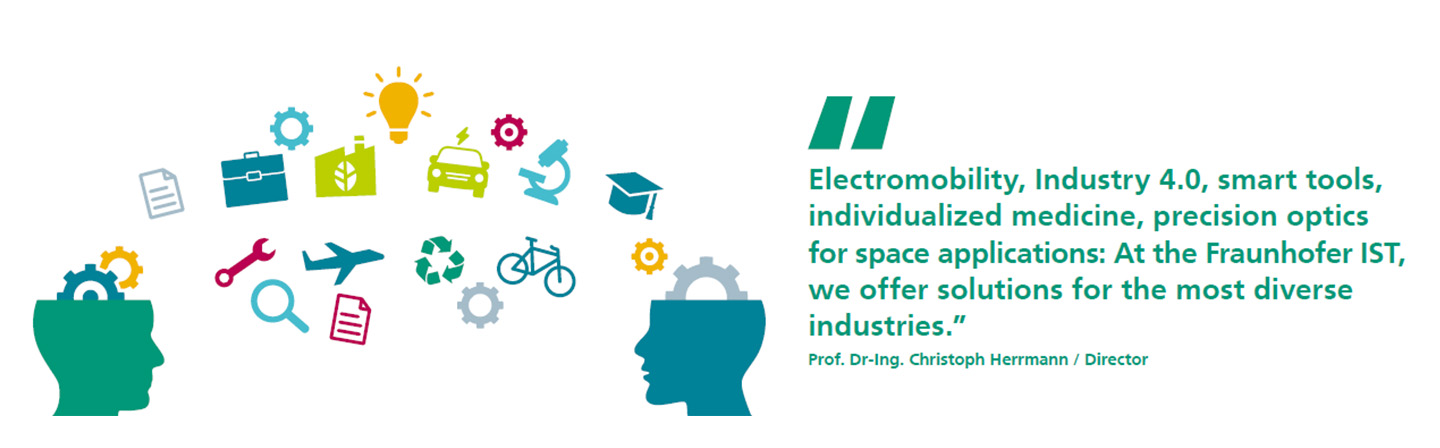
Institute profile for the Fraunhofer IST
As an innovative and internationally recognized partner for research and development, the Fraunhofer Institute for Surface Engineering and Thin Films IST develops future-oriented products – including the associated competitive and scalable production systems.
Surface technology for future-oriented products and systems
Our research encompasses plant engineering, entire process chains of process engineering, process technology and manufacturing technology all the way through to the consideration of entire factories. Taking the requirements of sustainability as a starting point, we maintain an overview of the entire product life cycle – from the material, through the process of creating the component and product, and on to recycling.
Tailor-made and sustainable: Our sector-based solutions
In interdisciplinary teams and based on our technology and competence fields, we offer our customers from industry and research tailored and sustainable solutions for various sectors, e. g. plant and mechanical engineering, tools, vehicle construction, aerospace, renewable energy, optics, medical and pharmaceutical process engineering, circular economy, electronics and the semiconductor industry. Drawing on a broad spectrum of expertise, technologies, processes and coating materials, we design the optimum process chain for the respective task, right through to the digital design of the entire factory.
A focus on our application fields and expertise
Currently, our experts are focusing their application-development expertise on the following areas:
- Sustainable battery and hydrogen systems
- Sustainability management and Life Cycle Engineering
- Circular products and processes
- Medical technology and pharmaceutical systems
- Optical and electronic Systems
- Diamond-based tools, components, and sensor systems
- Tribology, corrosion, and sensor technology
We apply our expertise in a diverse range of technologies for the coating, treatment and structuring of surfaces and the design of the associated production systems. These include:
- Electrochemical processes, in particular electroplating
- Atmospheric pressure processes
- Low-pressure plasma processes with the main focus on magnetron sputtering, highly ionized plasmas and plasma-activated vapor deposition (PECVD)
- Chemical vapor deposition with the main focus on hot-wire CVD
- Atomic layer deposition (ALD)
- Chemical, mechanical and thermal surface treatment
Furthermore, the Fraunhofer IST is very well equipped as regards surface analytics and has accrued many years of expertise in quality assurance. Added to this is extensive experience in the modeling and simulation of both product properties and the associated processes as well as production and factory systems. For the systematic consideration of sustainability requirements, the Fraunhofer IST offers extensive expertise in quantitative sustainability assessment and a circular economy using Life Cycle Engineering.
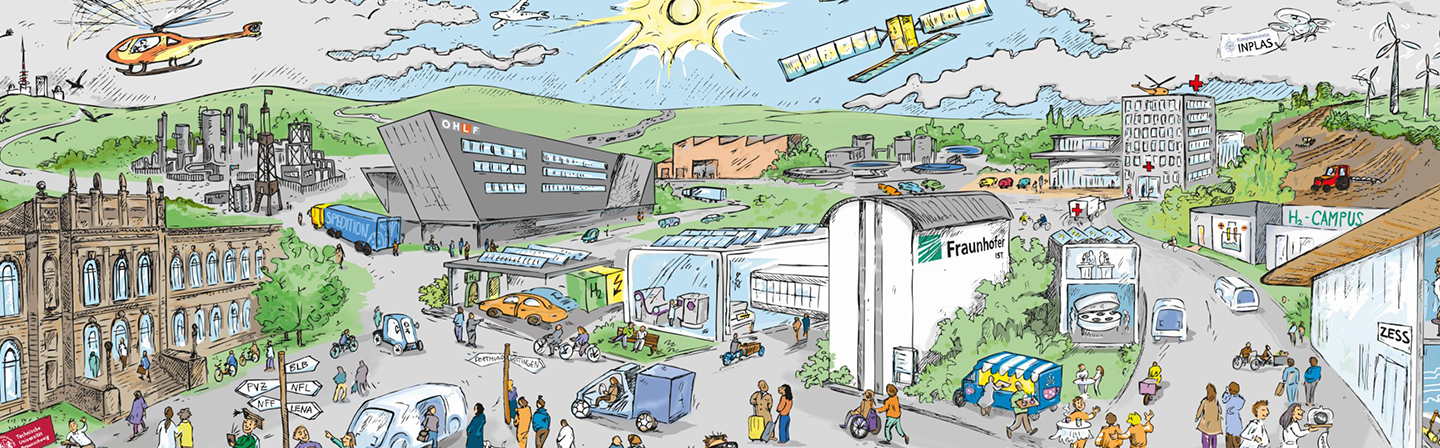
The Fraunhofer IST - locations, activities, networks, applications.