 Fraunhofer Institute for Surface Engineering and Thin Films IST
The quality assurance of coated components and tools often encompasses a complex visual inspection during which a large number of defects such as geometric deviations or coating flaws are detected and, consequently, rejects are identified. This process is, however, not only time-consuming, but also heavily dependent on the experience of the persons carrying out the inspection. In order to make this predominantly manual inspection process more efficient and to automate it, the three Fraunhofer Institutes ITWM, IGD and IST are working in collaboration with the TU Wien on the “SimVision” project, whose aim is the development of scalable approaches for AI-based visual inspection as well as methods for the generation of real and synthetic training data.
SimVision – Automated visual inspection for production


Defects and complex surfaces
The coating of tools and components encompasses a number of process steps that can lead to significant changes in the visual appearance and reflection behavior of the surfaces to be inspected. It must also be possible to detect diverse flaw patterns and defects on even complex geometries. For a reliable, AI-based visual inspection, extremely comprehensive image data sets are required, which usually cannot be generated in practice. As a result, quality control has, until now, generally been carried out by means of time-consuming manual visual inspections.
Automated inspection in production by means of rule-based training data
In the “SimVision” project, a flexible inspection system is being developed that automatically examines the surface quality in various phases of coating production. The basis for this is a combined database consisting of photographic images of real sample sets as well as rule-based synthetic data based on mathematical models of the surface structure, possible defects, and component geometry. This diverse, photorealistic training data enables the mapping of a wide range of potential surface conditions, thereby significantly improving the accuracy, flexibility and cost efficiency of the inspection system.
Flexible quality inspection with AI using the example of diamond tools
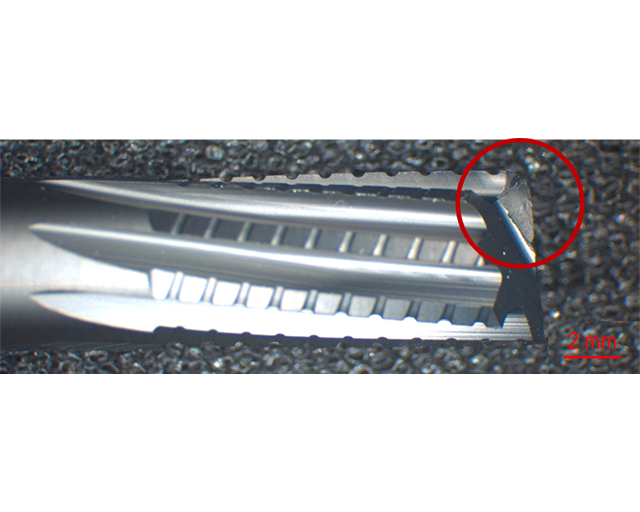
Conventional AI-based methods reach their limits when surfaces are highly reflective, have differing structures or exhibit geometrically complex shapes. In addition, fluctuating surface topographies and lighting situations impede the reliable detection of defects such as delamination, cracks, edge chipping or wear. Using diamond coatings as an example, physically based modeling of surfaces, defects, and light refelctions is utilized in order to generate realistic, synthetic training data for pre-treated and coated cutting tools.
Inspection system for coated tools and components
At the Fraunhofer IST, an automated inspection system is being constructed which will initially be trained in the recognition of defects in cutting tools coated with diamond. Subsequently, the detection of tool wear will also be investigated, and additional fields of application for the inspection of components and tools with PVD and CVD coating systems will be explored in order to ensure production quality.


The project
“SimVision” is being funded as an ICON project (“International Cooperation and Networking”). Within the framework of “SimVision”, researchers from the Fraunhofer Institutes for Industrial Mathematics ITWM, for Computer Graphics Research IGD and for Surface Engineering and Thin Films IST are working in collaboration with the TU Wien on the development of a scalable process chain in order to train artificial intelligence with real and synthetic data and to transfer it to industrial applications.