 Fraunhofer Institute for Surface Engineering and Thin Films IST
The heart of the RAINBOW hyperspectral instrument is formed by an innovative bandpass filter which was developed at the Fraunhofer IST on the basis of filter-on-chip technology.
Project Rainbow

Climate change and a growing global population pose enormous challenges for agriculture. Declining yields, increasingly extreme weather conditions, and pest infestations threaten global food security. At the same time, the sustainable use of resources requires more targeted management of agricultural land. Existing multispectral systems provide valuable data, but they do not capture all the spectral absorption bands necessary for a complete analysis of plant condition. There is a lack of compact, cost-effective solutions that enable hyperspectral imaging for widespread use, for example via small satellites.
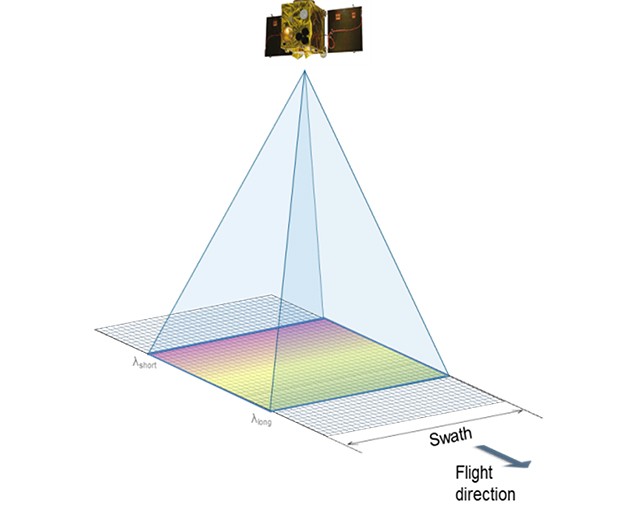
In the ESA-funded RAINBOW project, Fraunhofer IST is working with Airbus Defence & Space, VISTA GmbH, and Fraunhofer IOF to develop a novel approach to hyperspectral remote sensing. The central element is a bandpass filter based on filter-on-chip technology, which integrates more than 30 spectral bands from 400 to 1700 nm. Three linearly variable bandpass filters, including broadband blocking, are combined on a glass substrate measuring just 10 mm. In order to achieve the high spectral variation of over 122 nm or 27% per millimeter and to cleanly separate the individual filter ranges, Fraunhofer IST uses state-of-the-art microstructuring techniques such as photolithography and lift-off processes. The result is an extremely compact, robust, and cost-efficient component that is ideal for use on small satellites.
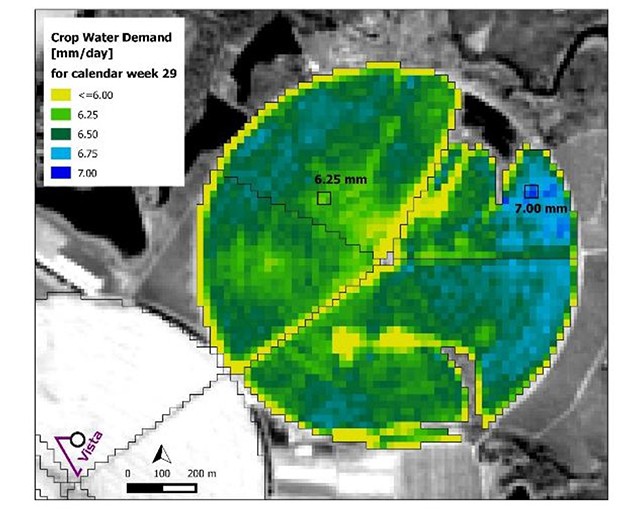
Thanks to high-resolution hyperspectral sensor technology, RAINBOW enables a significantly more precise and quantifiable analysis of plant condition, including nutrient supply, stress factors, and water content. This creates a basis for more efficient and sustainable management strategies, as farmers and agricultural service providers can make informed decisions and use resources in a targeted manner. At the same time, operators of small satellite platforms benefit from compact and economical technology that provides access to high-quality hyperspectral data and enables new remote sensing applications.

More about the project:
incubed.esa.int/portfolio/rainbow